
How can I estimate the volume of a mixed load without guessing from bag count?
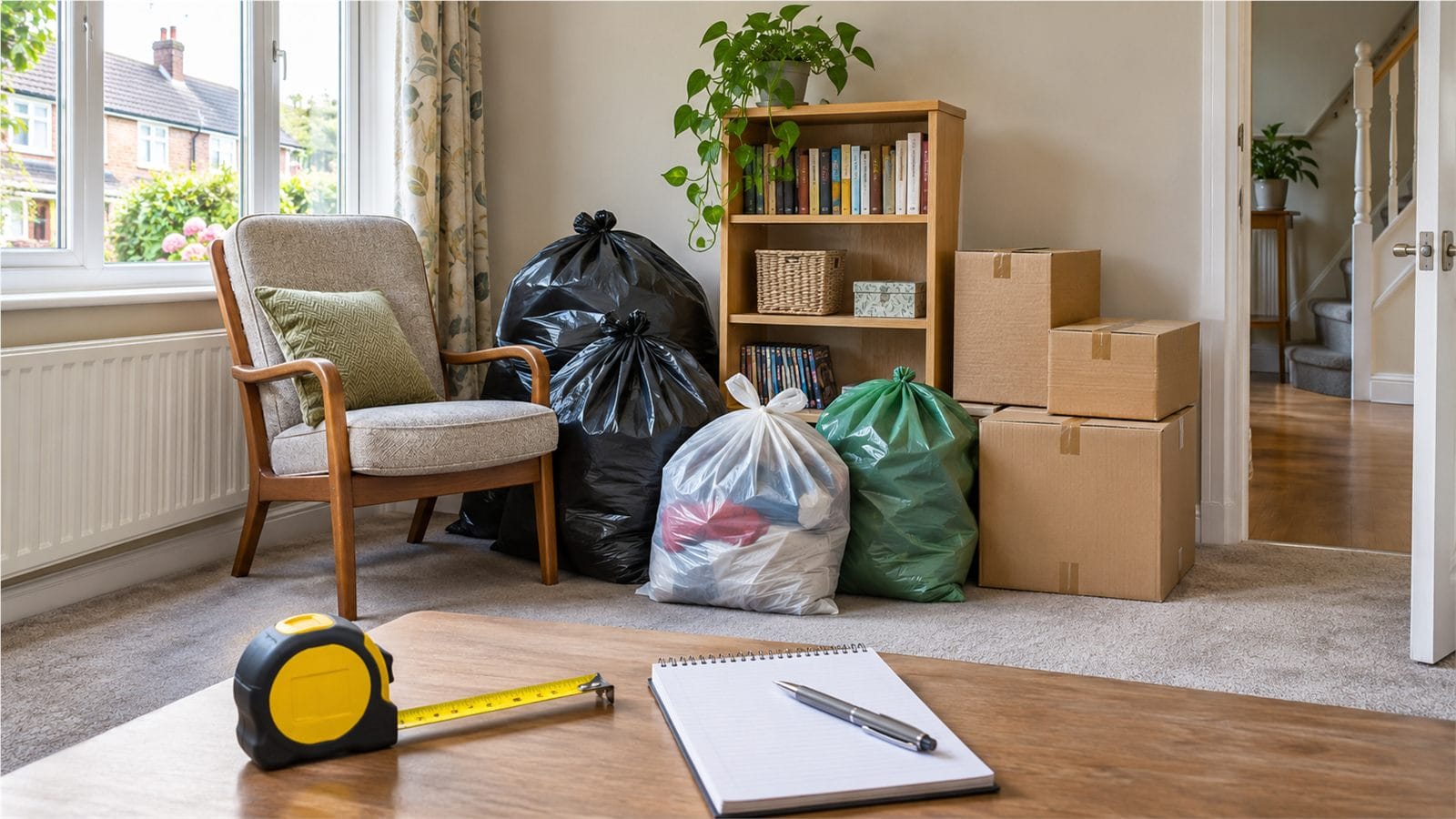
Ten bags do not describe a useful volume. Ten small, tightly packed bags of clothes may occupy less space than ten partly filled sacks of bedding. A broken chair, two empty boxes and a rolled rug add shapes that a bag count cannot capture at all. If you need an approximate volume for a household clear-out, measure the space the items occupy or their outside dimensions, then state what you have assumed. The answer can be a range. It does not have to pretend that loose rubbish forms a perfect block.
This is a household measuring method, not a pricing guide. It helps you understand your own inventory and communicate its scale. A collector will still assess the actual items, access, handling and acceptance. The published household waste removal service discusses collection enquiries; the method here concerns the arithmetic behind a volume estimate.
Choose one unit and keep it throughout
Volume is length multiplied by width multiplied by height. If all three measurements are in metres, the result is in cubic metres, written m³. A box that is 0.6 m long, 0.4 m wide and 0.5 m high occupies 0.12 m³ as an outside rectangular shape: 0.6 × 0.4 × 0.5. You can use centimetres, but convert before combining figures. One metre is 100 centimetres, so 60 cm is 0.6 m.
A tape measure and a note on your phone are enough for a small load. Write dimensions in the same order each time, such as length × width × height. Measure the widest points of the item as it will be moved, including handles or fixed legs where they affect the space used. Do not measure a drawer’s inside storage capacity when the whole chest of drawers is the object leaving the home.
Round to a sensible level. Measuring a sack to the nearest millimetre gives false precision when its shape changes as soon as you lift it. For a large item, the nearest few centimetres may be useful; for a loose pile, a range is more honest. State whether the estimate uses outside dimensions, a measured stack or a rough pile boundary.
Measure regular boxes first
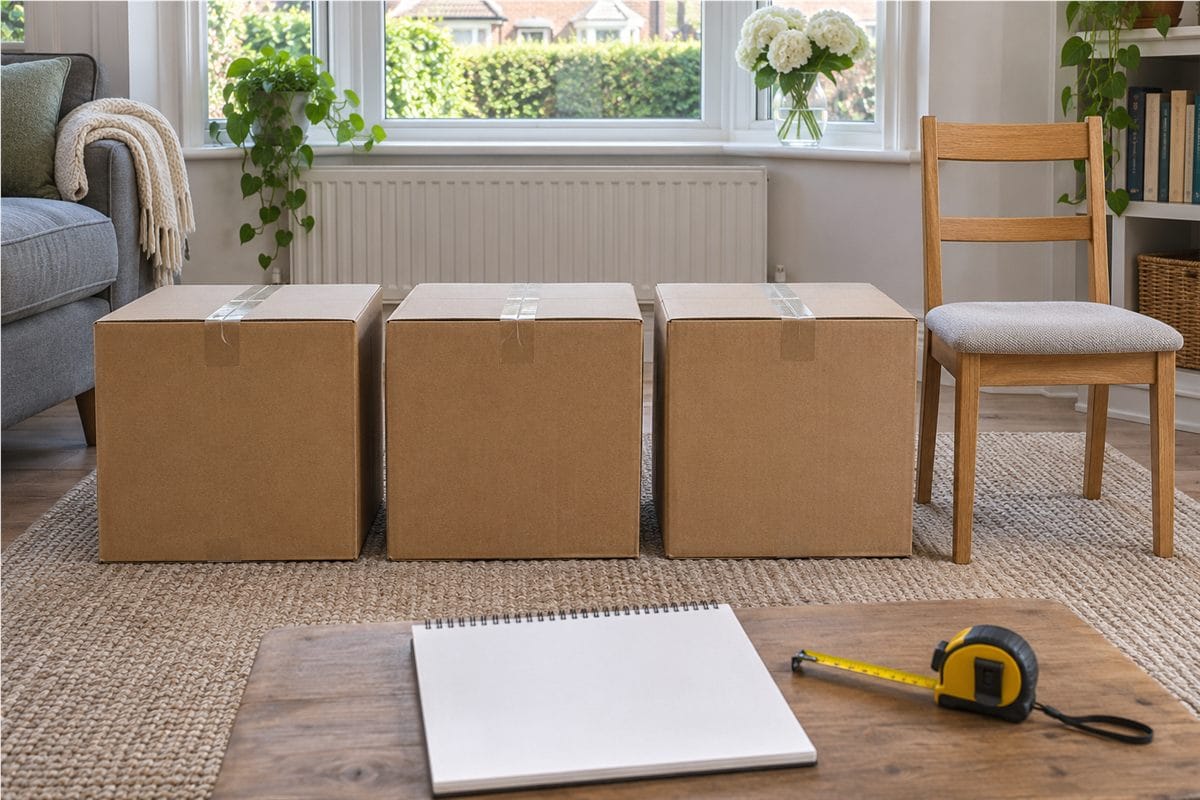
Cardboard boxes are the easiest part of the load. Measure one box’s outside length, width and height, then multiply. If five boxes are genuinely the same size, multiply that volume by five. If the boxes vary, split them into size groups. A photograph of three box sizes with a tape measure visible can help you remember which group is which.
Do not use the printed capacity from a storage-box label without checking what it means. A label may give internal capacity in litres, while the space occupied in a vehicle depends on outside dimensions and lid shape. A 60-litre tub does not necessarily consume exactly 0.06 m³ when stacked with other items. It may have sloping sides, projecting handles and a lid that prevents close stacking.
For nested empty containers, record that they will be nested and measure the resulting stack. Five empty tubs placed inside one another can occupy much less space than five sealed tubs of belongings. For sealed boxes, count the external volume of each unless you know how they will be safely stacked. The contents may be light or heavy, but the outside dimensions are the starting point for volume.
A worked box example
Suppose you have four medium boxes measuring about 0.50 × 0.40 × 0.40 m. Each occupies about 0.08 m³, making 0.32 m³ for the group. Two larger boxes at 0.70 × 0.45 × 0.45 m occupy about 0.142 m³ each, making roughly 0.284 m³. Together, the six boxes have a simple outside-volume total of about 0.60 m³. That total says nothing yet about furniture or gaps between items.
The arithmetic is easy to check later if you keep each line in a short table: item group, quantity, dimensions and calculated total. If a box is removed from the clear-out, delete its line rather than estimating the whole load again from memory.
Treat furniture as bounding shapes
For a chair, bedside table or cabinet, measure the smallest rectangular space that contains the item in its likely transport position. The resulting bounding-box volume will include air around legs or curves. That is acceptable as a first estimate because an irregular object cannot fill every corner of a vehicle. Label it as a bounding estimate rather than claiming it is the item’s solid material volume.
A dining chair may be 0.50 m wide, 0.55 m deep and 0.90 m high, yielding about 0.25 m³. Four chairs at that simple figure total about 1.0 m³. They might nest and use less space if their design allows, or they might not stack safely at all. Do not reduce the volume because you imagine a perfect arrangement that has not been tested. If they actually stack, measure the real stack and record that condition.
For a sofa or large cabinet, note the dimensions and whether it can legitimately be separated into sections. A modular sofa may have detachable modules; a fixed sofa does not become “flat packed” merely because it is awkward. If you plan to dismantle an item, make sure the method is feasible and that the measured pieces are what will be presented for collection. Do not rely on a hypothetical reduction to make the estimate look small.
Measure furniture as it stands unless a responsible person has already decided on safe disassembly. The dimensions also help you check whether the item fits through a doorway, though route measurement is a separate question from load volume. A unit that will not pass a narrow stairwell needs an access plan even if it occupies little space in cubic metres.
Use a measured footprint for sacks and loose piles
Soft bags change shape. Rather than assuming every sack equals a fixed volume, put similar closed bags together in one tidy layer and measure the group’s length, width and average height. If the group is 1.2 m long, 0.8 m wide and roughly 0.5 m high, its bounding volume is about 0.48 m³. The true packed volume may be lower because of gaps. Record it as “about 0.5 m³ in current stack”, not as an exact material volume.
If bags are still scattered around a room, count only those that are actually leaving and move them together if it is safe to do so. Do not fill a bag with bulky, sharp or heavy waste just to create a more convenient unit of measurement. Keep material suitability and safe handling separate from the calculation. A small bag of rubble may weigh more than a large bag of bedding while taking less space.
For a loose pile, mark the longest and widest edges on the floor and estimate its average height. The highest point alone will exaggerate the volume if the pile slopes sharply. You can divide a complex heap into two or three simpler blocks and add them. For example, a low base of boxes and a taller corner of cushions are easier to measure separately than as one imagined cube.
Photograph the pile from two directions with a familiar object or tape measure for scale. A single close-up can make a small pile look huge or hide material behind the camera angle. Keep the floor visible where possible so someone reading the estimate understands its footprint.
Handle long and awkward items separately
Rugs, poles, dismantled bed frames and branches may have a small calculated volume but be difficult to place among boxes. Note their longest dimension and shape as well as their volume. A rolled rug measuring 2 m long and 0.3 m across has a relatively small theoretical volume, but its length may determine how it can be carried or loaded. A flat panel may occupy little material volume yet prevent stacking if it must remain intact.
For cylinders such as a rolled rug, you could use the cylinder formula, but the extra precision is rarely useful in a mixed load. A rectangular bounding shape, 2.0 × 0.3 × 0.3 m in this example, gives an upper planning figure of 0.18 m³. Mark it as a long item. The note about length is more useful than debating the exact amount of air inside the rectangle.
If an item is fragile or cannot bear weight, do not assume other pieces will be stacked on it to remove gaps. A glass tabletop needs protective handling, and a lamp shade may need its own space. A volume estimate that ignores these limits can be mathematically neat and operationally misleading.
Add a range rather than a false exact total
Once you have group figures, add them. Suppose your boxes total 0.6 m³, furniture bounding boxes total 1.4 m³, and the current sack stack occupies about 0.5 m³. The simple sum is 2.5 m³. Because furniture has open spaces and the final arrangement is unknown, describe the load as approximately 2–3 m³, with the item list and photos attached. The range reflects uncertainty rather than an error in arithmetic.
Do not apply a universal “compression factor” to every mixed load. Soft bedding can change shape; rigid cabinets, glass and appliances cannot be compressed in the same way. Whether chairs can nest or boxes can stack depends on their design and contents. If you need more confidence, arrange the actual items into a safe, accessible group and measure that group. That is stronger evidence than a generic bag-to-cubic-metre conversion copied from a price list.
Keep weight as a separate consideration. Volume does not reveal whether an item is unusually dense. A small pile of tiles or soil may require different handling from a much larger pile of cardboard. List heavy materials explicitly; do not let a modest cubic-metre figure hide them. The receiving service may assess weight, access and excluded materials independently.
Check the estimate against reality before using it
Walk through the home once more and compare the written list with what is actually leaving. Open drawers only to verify whether their contents are included, not to add forgotten items silently at collection time. Mark retained, donated and discarded pieces differently. An estimate can be technically correct for the wrong inventory if the family’s decision changes after measuring.
Take one wide photo of the whole grouped load and separate photos of large or unusual pieces. Keep dimensions for the largest items and a note of anything that changes the handling, such as a fragile panel or long rug. If you ask about household waste removal, describe the measured group and confirm what the service accepts. The measurement gives a clearer starting point; it is not a binding quote or a promise that everything pictured belongs in one collection.
The method is repeatable: identify the leaving items, measure regular shapes, bound irregular ones, measure actual stacks where possible, then add and report a sensible range. It replaces a guess based on bag count with transparent arithmetic and a few photographs. Anyone reviewing the load can see what the number includes and where uncertainty remains.