
What to Do With Reusable Books During a House Clear-Out
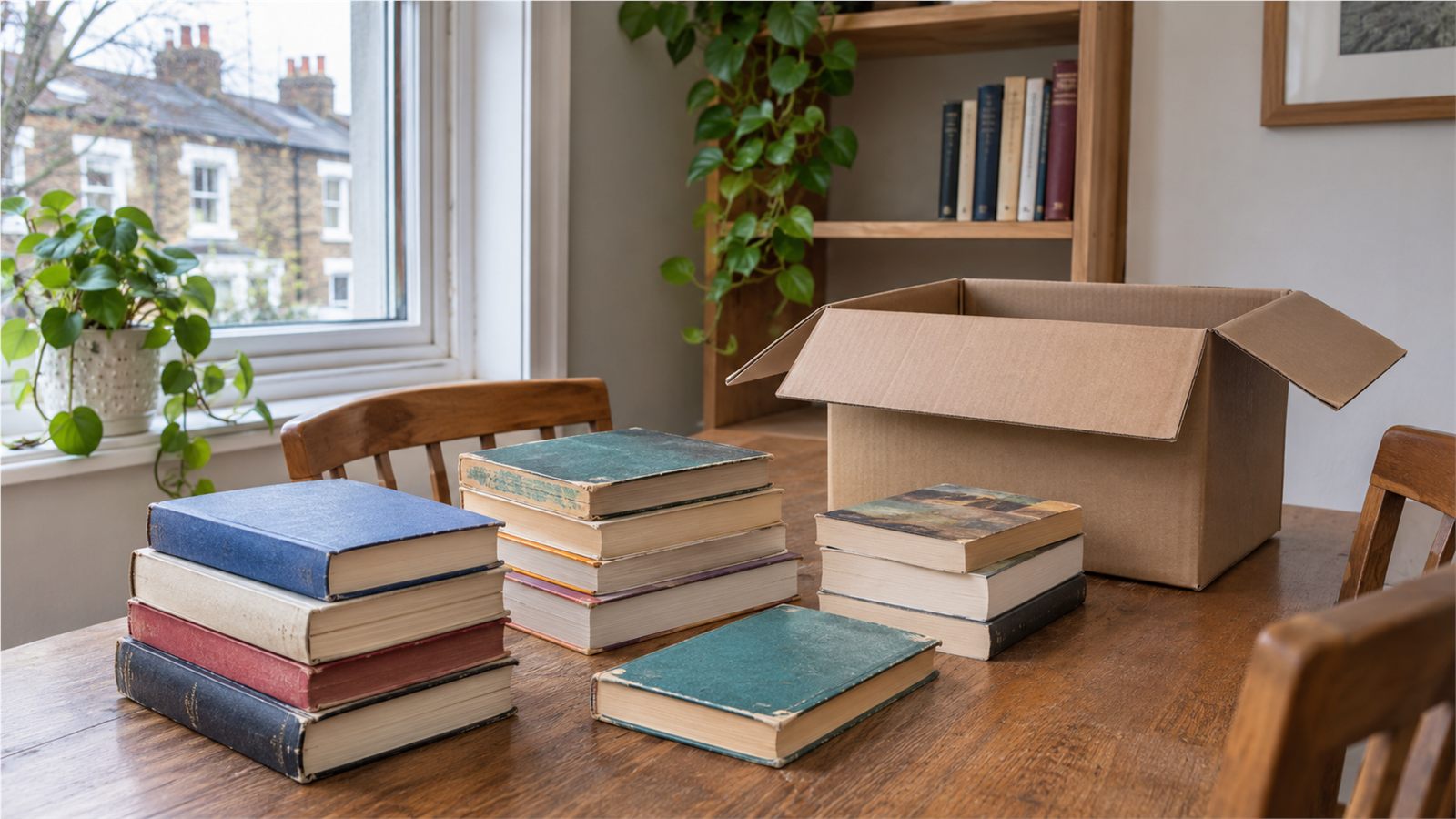
Books are easy to overlook when planning a house clear-out. A single shelf seems manageable, but several rooms of books can turn into dozens of heavy boxes. Some volumes have a reader waiting for them. Others have been damaged by damp, contain private notes or have no realistic reuse route. The useful first question is not “How quickly can we carry these away?” It is “Which books should stay in circulation, and which need another destination?”
Sorting books well does not require a specialist catalogue. It requires a clear boundary between family copies, good candidates for donation, items that need checking and damaged books. Once those groups are separate, you can choose a recipient or a local collection route with fewer wasted journeys.
Pull out books that need a family decision
Before filling a donation box, look for inscriptions, photographs, letters and documents tucked between pages. A book that looks ordinary on the shelf may be a signed gift or contain a family note. Ask the people involved whether there are authors, subjects or individual volumes they want to keep. Put these books in a marked area, away from the pile for removal.
You do not need to inspect every page of every paperback. Focus on older books, albums, Bibles, recipe books with handwritten notes and volumes from a family member’s working collection. Check any book with loose papers sticking out. If the property is being cleared by several people, one person should record what has been reserved and where it has been moved.
For a large collection, take photographs of shelves before changing their order. A wide shot records how books were grouped; closer images can help a relative identify a title remotely. If someone wants to review the collection later, keep it in one labelled room or in numbered boxes. “Books from upstairs study, shelf two” is far more useful than “mixed books”.
Assess what someone else can actually use
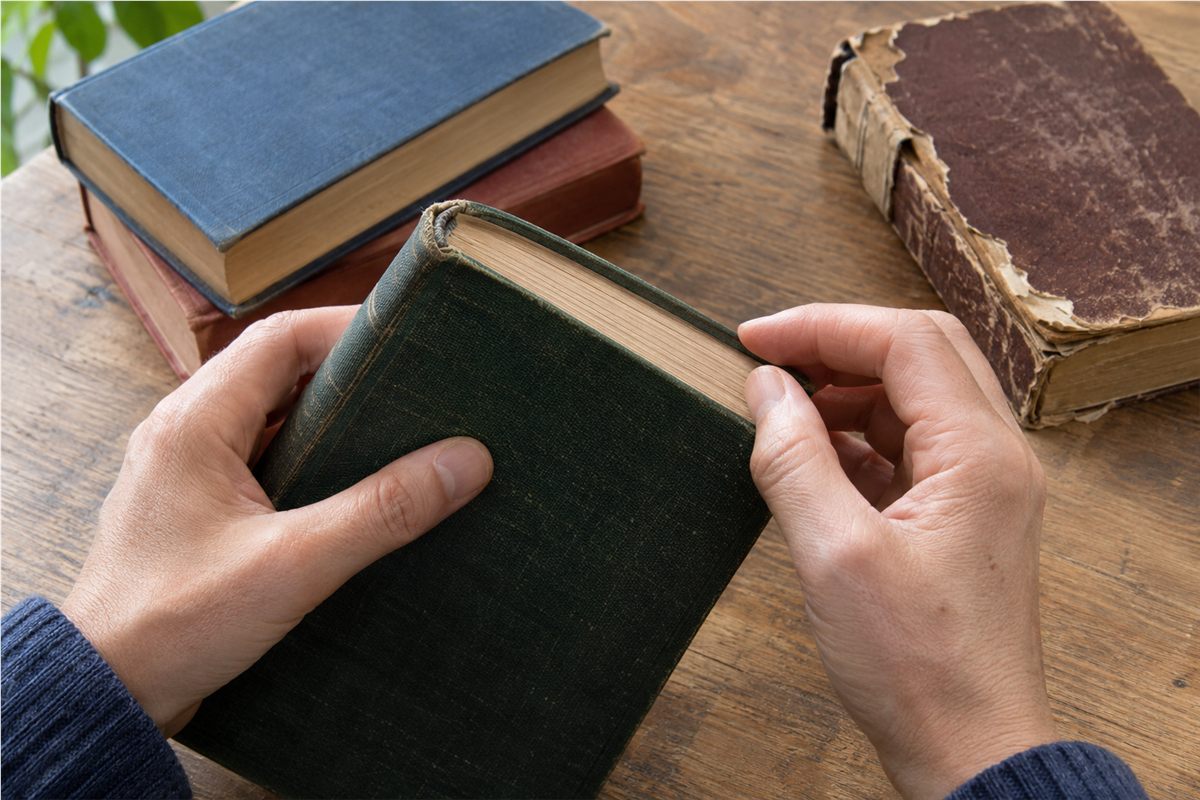
Look at condition with a recipient in mind. A clean, complete book with secure pages is a plausible donation. A volume with mould, extensive water damage or missing pages is not. Old does not automatically mean valuable, and new does not guarantee useful. Sort on physical condition and likely demand rather than assuming a charity can sell everything you no longer want.
Separate reference books, children’s books, novels and specialist titles if there are enough to justify it. This helps when contacting a school, community group or book charity. Be realistic about dated guides: a decade-old travel handbook or technical manual may contain information that no longer serves a reader. Some books may have interest as historical objects, but that is a different question from whether they work as current advice.
Do not try to improve damaged books for donation by hiding their faults in the middle of a box. A charity has to spend time sorting every bag and may incur costs to dispose of unsaleable stock. Oxfam’s donation guidance lists books among accepted items but also says it cannot take broken, dirty, incomplete or unsafe goods. Use that as a practical condition check, then ask the particular shop whether it has capacity.
Check for books with unusual value or meaning
If a book appears rare, signed or part of a matching set, do not send it straight to a general paper stream. Note the title, edition information and condition, and ask someone knowledgeable to review it if its value matters to the family. Oxfam says it accepts rare and antiquarian books and has ways to assess them, but you may also choose another specialist recipient. The decision belongs to the owner or person authorised to manage the belongings.
Family value may have nothing to do with money. A worn children’s book with a handwritten dedication may be worth retaining even if it would fetch little in a shop. Put these personal choices ahead of a quick calculation of how many boxes must leave.
Arrange a recipient before packing the whole collection
Phone or check the website of a local charity shop before arriving with a car full of books. Oxfam notes that most of its high-street shops accept books, but shops can be temporarily at capacity. Explain roughly how many boxes you have and the types of books. A shop may suggest bringing a manageable amount, using a specialist bookshop or trying another date.
Other routes may suit a particular collection. Friends and neighbours may want recent novels or children’s books. A community book swap may take small quantities. Schools, libraries and voluntary groups have their own acceptance policies; ask them first rather than leaving boxes at a door. A group that has not requested the books may lack the staff or storage to process them.
Offer clear descriptions if you use a local sharing group. “Three boxes of clean children’s picture books, suitable for ages roughly three to six” is easier to match with a reader than “loads of books, collect today”. Set a reasonable collection deadline and have a fallback for anything not taken. This avoids a hallway full of half-sorted boxes remaining for weeks.
Pack for weight and traceability
Books become heavy quickly. Use smaller sturdy boxes and test the weight before filling them to the top. Fill empty space with lightweight packing material if needed, rather than adding more hardbacks simply because there is room. Label each box with its destination and broad contents: “Donate — novels”, “Family review — cookbooks” or “Local recycling check — damaged books”.
Keep the boxes dry. A collection of sound books can be spoiled by one night outdoors in rain or a damp garage. Do not leave donations on a pavement outside a closed shop. If a recipient agrees to collect, confirm the place and time, then keep the boxes accessible but protected until the handover.
If several people are helping, make labels large enough to read at a glance. A handwritten mark on the bottom of a box is not a reliable instruction once boxes are stacked. Use a different colour or a separate area for “keep” and “donate” so they cannot be confused in a busy clear-out.
Do not assume books belong in kerbside paper recycling
Recycle Now’s book guidance explains that books cannot usually go in kerbside paper recycling because of the glue in the binding. It says some recycling centres accept unwanted books and recommends passing usable books on where possible. That is a general UK guide; the actual route depends on the local authority and the site you intend to use.
Check the council’s current instructions for the property postcode. For example, Sutton’s Community Reuse Shop describes books among the reusable goods at its centre, while Westminster describes micro recycling centres that can take books. These examples show why a single London-wide rule would be misleading. Eligibility, booking and accepted materials can differ by borough and location.
Do not try to solve the binding issue by assuming that every damaged hardback can be put in the same container as loose paper. Follow the centre’s posted categories or ask staff. If the books are wet, mouldy or contaminated, explain their condition and check the correct disposal route. The item is only recycled if it reaches a facility that actually accepts it.
Keep the final house clearance list honest
After the keep and donation decisions, list what remains by room and approximate box count. Say if the books are boxed, loose on shelves or mixed with other possessions. If the load also includes furniture, appliances and household contents, discuss the remaining scope through the house clearance service. The team can assess the actual items and carrying route rather than a vague description of “a library”.
Make clear which boxes are not part of the removal. A relative may be coming for one marked set, while another group is awaiting a charity reply. Keep those groups physically separate from the removal area. If the charity later declines the donation, update the list before the collection instead of silently adding several heavy boxes.
The best result is not necessarily an empty bookshelf in a single afternoon. It is a clear decision for every group of books: retained for a reason, passed to a willing reader, accepted by a real reuse or recycling route, or accurately described for disposal. That approach respects both the books and the people who must manage the property after the clear-out.